

What do we mean by Breastfeeding?
Breastfeeding, or nursing, is the process by which human breast milk is fed to a child. Breastfeeding is the foundation of life and must be made a norm mandatory for every mother to breastfeed as it is the birth right of every infant to be breastfed. Formula feeding is just an alternative and doesn’t have the qualities of a mother’s breast milk that’s protective in nature.
Is really breastfeed so necessary?
The American College of Obstetricians and Gynecologists (ACOG) therefore recommends 6 months of exclusive breastfeeding for all infants.Trusted health organizations like the American Academy of Pediatrics (AAP) strongly recommend exclusive breastfeeding for the first 6 months and continuing after solid foods are introduced, until at least the age of 1 or longer.
Uninterrupted skin-to-skin contact and breastfeeding can begin immediately after birth, and should continue for at least one hour after birth. Apart from developing a strong immune system in infants, breastfeeding has many other health benefits and prevents the child from chronic diseases.
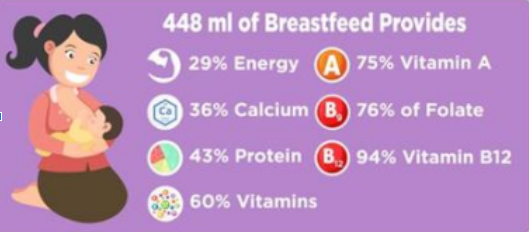
Breast milk contains hormones that help in regulating food intake.Breast milk contains everything your baby needs to grow and develop. It provides a unique and specific formula of vitamins, minerals and antioxidants.
Statics of Women who breasfeed:
18% - Women choose not to breastfeed at all
35% - Started Breastfeeding but stopped within one week.
only 5% - Continue to Breastfeed for More than a Month
Advantages of Breastfeeding to Infant :
- Easily digested
- Protection against infection
- Perfect nutrients
- Lower sudden infant death syndrome
- Supports baby’s growth and development
- Greater IQ
- Helps baby to develop immune system
Advantages of Breastfeeding to Mother :
- Protect mothers health
- Helps bonding and development
- Lowers risk of Post Partum Depression
- Decrease risk of breast and ovarian cancer
- Aids in return to pre pregnancy weight
- Is cheaper than formula feeding
What is Colostrum?
The first type of milk produced is called colostrum. It is produced during pregnancy and the first days after childbirth, colostrum is rich in protein and Vitamins A, B12 and K, which supports infants' growth, brain development, vision, immune systems, red blood cells, and clotting cascade. It helps to stop harmful germs that can make your baby sick. Colostrum does this by coating your baby's digestive system so that germs have no place to grow.
Breast milk is always fresh and exactly the right temperature. It is ready for your baby whenever they are ready to eat. You do not have to heat it, boil water or sterilize bottles. This makes feedings so much easier! Since breast milk is always with you, travelling or shopping with your baby is easier.
| BREASTFEEDING | FORMULA MILK | |
| ADVANTAGE | ✓ Has Antibodies, no bacteria ✓ Nutrients in correct proportion ✓ No risk of allergic reactions ✓ No additives, preservatives ✓ Benefit to mother and child health | ✓ Less painful ✓ Can be feed by someone else to baby ✓ May contain supplements of nutrients and vitamins |
| DISADVANTAGE | ✓ May be painful ✓ Mother needs to be present | ✓ More likely to develop illness like diarrhoea, infection ✓ Does not contain antibodies ✓ Expensive ✓ Harder to absorb ✓ Risk of wrong mixture |
Formula feeding is associated with adverse health outcomes for both mothers and infants, ranging from infectious morbidity to chronic disease. Given the compelling evidence for differences in health outcomes, breastfeeding should be acknowledged as the biologic norm for infant feeding.